














Among the numerous controversies in Hawai‘i, one that seemingly has an impact only on few has been standing since the 1970s: marijuana legalization. As long-lasting as it is, it has layers of clashes, from its impact on health to the state’s economy. While many in Hawai‘i believe legalization allows for better regulation and response, others, including many in ‘Iolani—up to 64%, in fact—believe marijuana should be illegalized to some extent, given its potential risk to health and safety.
Status quo in and outside Hawai‘i
Although marijuana is federally a Schedule 1 substance, meaning it cannot be prescribed medically and is deemed to have high potential for abuse, individual states have varying laws. In Hawai‘i, marijuana can only be purchased after medical prescription, while small amounts (<3 grams) are decriminalized, meaning it is technically illegal, but those caught would only face consequences of committing a civil offense, such as fines. Some of this legislative session’s disputes surrounded Senate Bill 3275, which would legalize the personal adult use of cannabis, its cultivation, and accessories. It has currently passed the second reading and is pending its decision from a Senate committee. On a national level, 24 states out of 50, in addition to two territories and the District of Columbia, legalize the adult use of recreational
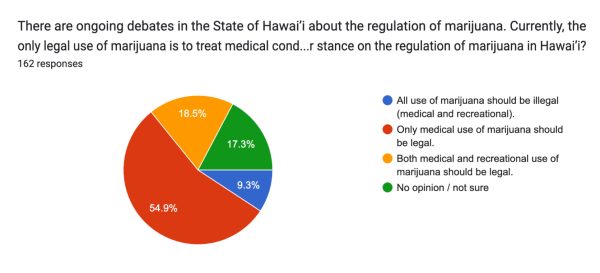
Then what do people in ‘Iolani and Hawai‘i believe about this issue? In the state, the general trend where the majority support recreational marijuana legalization is consistent across different polls, ranging from 58% to 86%. There has also been growing support, with only 36% supporting it in 2017, in contrast to 43% in 2021 in two polls done by the Honolulu Civil Beat. Interestingly, this shows a contrast to Imua’s poll out of 163 students: when asked for their opinion on the legal status of cannabis, 55% replied only medical use should be allowed, while 18.5% supported recreational use as well, and 9% supported complete illegalization.
How does marijuana impact individuals?
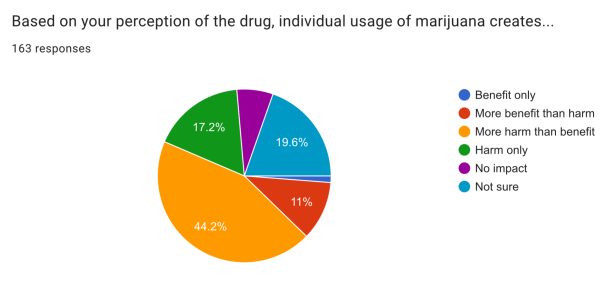
Opposers to legalization emphasize the proven health risks of marijuana, as it is, at the least, not a benign substance. This seems to align with many of the students’ perspectives: in the same survey, the majority replied that an individual’s usage of marijuana causes either more harm than benefit (44%) or harm only (17%), while relatively few (12%) replied it creates more benefit or benefit only.The substance can lead to higher anxiety and depression, or even schizophrenia and psychosis, especially for youth or those with pre-existing mental issues. Its impacts are wide ranging, from brain and mental health and athletic performance to correlating with overall worse career or educational outcomes.
However, on the same Imua poll, 7% replied there is no impact: along this line, supporters of legalization assert that the impact is relatively negligible, especially compared to legal substances. Mr. Josh Frost, a policy advocate at American Civil Liberties Union (ACLU) of Hawaii, a non-profit that advocates for fundamental rights, said, “Both alcohol and tobacco kill thousands and thousands of people a year [respectively 178K and 480K in the U.S.], whereas there’s really no evidence that people die [directly] from cannabis. So we have these two drugs that are legal, taxed, and regulated,” yet cannabis remains illegal. He also noted that “cannabis is not addictive … at the same level tobacco is,” and argued there is no direct proven evidence that cannabis is a gateway drug, especially when compared to alcohol, which is more likely to be the initial substance used.
How would legalization affect public health and safety?
Those for legalization believe legalization improves public health and safety. Mr. Frost said, “There’s no way of knowing how potent [cannabis bought in the black market] is…[and] what else might be in it. Whereas if it’s legal, now you have government regulated structures to do testing so they can verify content and potency, and you know exactly what you’re getting when you buy it.” In other words, regulation actually allows for safer products for a demand that exists regardless of whether or not the drug is legal. He later added, “At least in some states where cannabis has become legal, teen use has actually dropped,” as regulated, legal procedures for purchase makes it less accessible than illegal pathways.
Conversely, others believe increased accessibility poses risk to public health. Dr. Mike Ching, pediatrician and Vice President of the American Academy of Pediatrics, Hawaii Chapter, stated, “increase in availability of marijuana to the general population is bound to have some negative consequences, especially for children.” For instance, Colorado saw a 20% increase in hospitalization following legalization of medical marijuana, then a 100% jump following its commercialization.
One concern is the impact on the younger population. To this, Dr. Ching noted, “some of these edibles are packaged as attractive, candy-like substances, and a young child may have a difficult time telling the difference between marijuana-containing gummy bears and regular gummy bears or Skittles,” making children more susceptible to overdoses, especially accidental ones.
Kai L. ’29, a student who advocated for cannabis illegalization for his C+CE class project, also shared how teenagers would be more likely to use it, as “it could easily be exposed to children or teens like me, and it could be a gateway to bigger drugs,” as teenagers are less likely to perceive its dangers and try it “out of curiosity.”
Hawai‘i’s context adds to the discussion
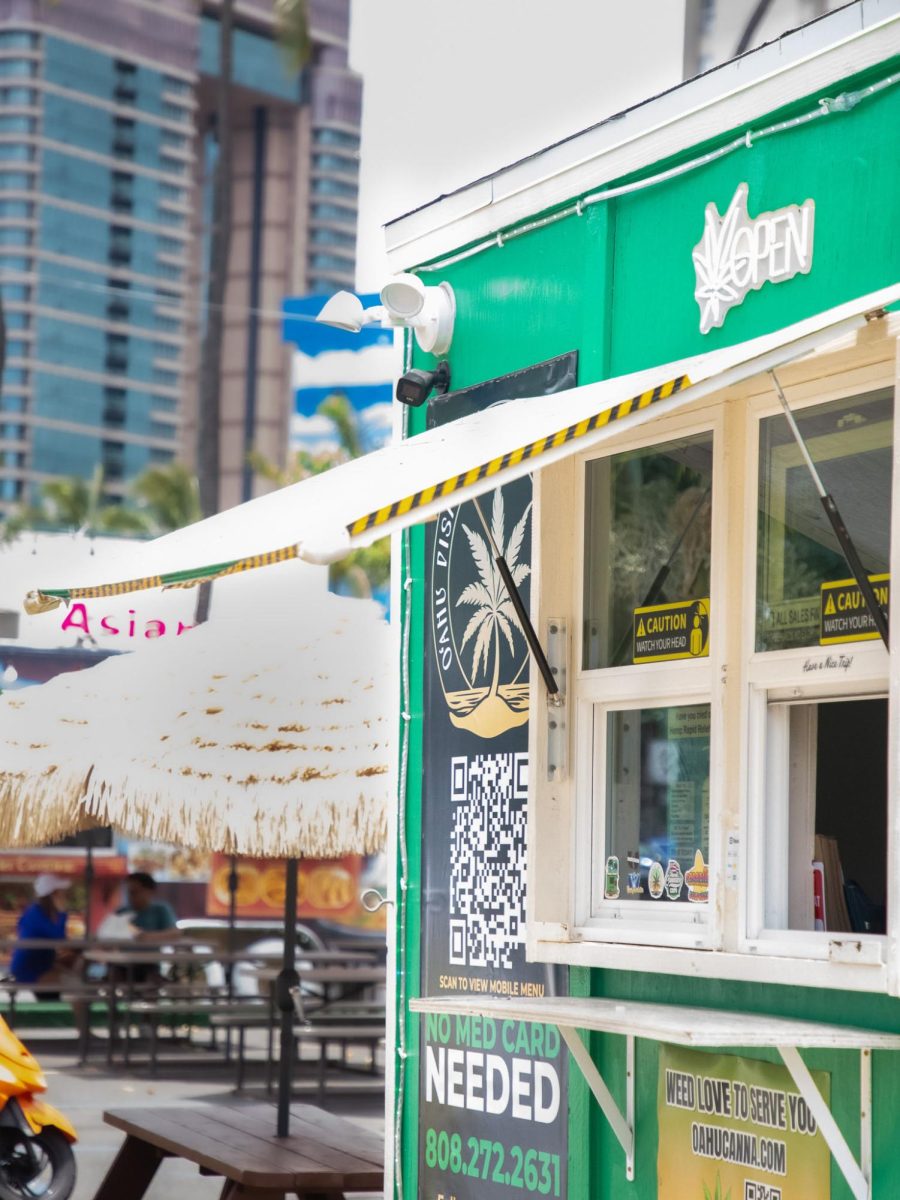
Then, the unique context of Hawai‘i should be considered. One rationale for legalization is to improve the criminal justice system, with certain ethnicities, such as Native Hawaiians, currently disproportionately arrested for drug offenses. In addition, in a state that seeks economic diversification from tourism, legalization not only generates tax revenue, but also jobs and local businesses: reports show that only a fourth of marijuana consumers are for medical purposes, while the entire market is expected to generate $16.5-32M monthly, reflecting on the potential for a thriving market. Tourism itself is also expected to add at least an additional $11.5M following legalization. However, even if marijuana were legalized, Mr. Frost said, “it’s still technically illegal under federal law,” making it trickier for both individuals and farms or companies that ship products for testing and packaging.
Looking forward
In the end, as Kai shared, “it’s not really a black[-and-]white thing:” many of the stances lie on a continuum with varying details on the scope of regulation or consequence. Mr. Frost presented his stance as harm-reduction: “rather than tak[ing cannabis] users in jail, there needs to be an effort to increase treatment… Instead of being treated as criminals, they need to be treated as patients.” Dr. Ching also shared his belief that it should be decriminalized as a “civil offense” rather than a criminal one, adding nuance to his stance.
The start would be to be better informed of facts: for instance, while studies have indeed shown it does harm general health, the extent of marijuana’s risk on individual health may be overestimated by many ‘Iolani students. At the same time, with conflicting facts, statistics, and precedents, it is hard to foresee the impact on Hawai‘i. This calls more people to learn from places with varying policies, while deliberating on how those may play out in the state’s specific context.