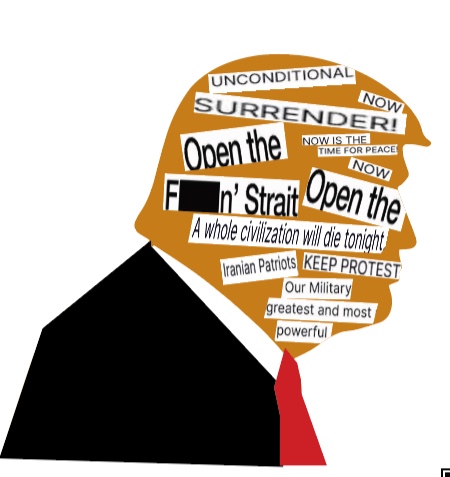

















“The lives of courageous American heroes may be lost, and we may have casualties,” President Donald Trump said in a video address after the United States and Israel launched joint airstrikes against Iran on Feb. 28, killing Iran’s Supreme Leader, Ali Khamenei. Since then, 13 U.S. service members have died as of May 8.
According to CNN, the killing of Khamenei marked the first time in modern history that the United States has openly assassinated a foreign head of state. By targeting Iran’s top leadership, military infrastructure and nuclear facilities, the operation triggered Iran’s retaliation, including the closure of the Strait of Hormuz, a vital route for roughly 20% of the world’s oil and natural gas.
AP U.S. Government teacher Ms. Sarah Johnson said, “Iran is a theocracy, and the leadership is very ideological. They’re very principled. They don’t care about the death of their people and the destruction to the global economy. They’ll fight to the end. So I feel like they could keep the Strait of Hormuz closed and cause global suffering. And they have a bit of an upper hand in some ways because of that.”
The economic effects were immediate. As U.S. inflation rates rose to 3.3% in March amid higher oil prices, the cost of everyday goods climbed even faster, with fresh vegetables up by 7.5%. In Hawaiʻi, where electricity depends heavily on imported oil, electricity prices are projected to rise 20% to 30% in the coming months, according to Honolulu Civil Beat. Dr. Taylor Stephens, instructor of Global Politics, said, “This conflict is affecting students’ lives as they go to gas stations, and whether they take an interest in the world as a whole, or just understanding how events are affecting their lives, it’s really important that they pay attention.”
History of the U.S.-Iran Relationship
To understand why President Trump chose to intervene, and why the conflict matters beyond rising prices, it is necessary to examine the U.S.-Iran relationship historically. Iran and the United States once enjoyed a period of strategic alliance prior to the 1979 Islamic Revolution. After World War II, Iran was seen as a strategic buffer against Soviet influence in the Middle East. In 1953, fearing Iran’s leaning toward the Soviet Union, the United States collaborated with Great Britain to overthrow Prime Minister Mohammad Mossadegh, who attempted to nationalize British oil industries within Iran. This strengthened the power of anti-communist Shah Mohammad Reza Pahlavi.
Since 1953, the United States has collaborated deeply with Iran, investing heavily in its economy and military. In 1957, the two countries signed an agreement that gave Iran access to nuclear education and technology. As the Shah benefited from U.S. aid, he launched a series of modernization reforms in 1963, including giving women the right to vote, promoting land redistribution and urbanization. These progressive reforms aimed to modernize Iran economically and socially. However, they also widened inequality between rural and urban areas and harmed the interests of religious leaders. The Shah’s increasingly authoritarian rule against dissident activities, and his close alignment with the United States, led many Iranians to view him as both a dictator and a Western puppet. In 1979, a revolution led by Ayatollah Ruhollah Khomeini overthrew the Shah and established the Islamic Republic, a theocratic system in which a senior Islam cleric, the Supreme Leader, holds ultimate authority over the government. After Khomeini’s death, Khamenei became Iran’s supreme leader in 1989 until his assassination in 2026.
Relations between Iran and the United States collapsed soon after the 1979 revolution, particularly following the hostage crisis, when American diplomats in Tehran were held hostage by Khomeini’s theocratic government. The two countries have had no formal diplomatic relations since 1980. It was during the Iran-Iraq war in 1980s that Iran began pursuing nuclear weapons, building on infrastructure developed during the Shah’s era. These histories help explain why the conflict with Iran today and the issue of Iran’s nuclear program are so multifaceted.
Justification of U.S. Involvement
1. Potential Nuclear Threats
In his video address, President Trump framed U.S. strikes as a response to Iran’s advancing nuclear and missile programs that would threaten U.S. bases in the region and even Europe or the mainland United States. in the near future. However, the timeline and complexity of that threat remain debatable. In 2015, Iran agreed to limit its nuclear program under the Joint Comprehensive Plan of Action (JCPOA), which imposed strict conditions requiring Iran to reduce uranium stockpiles or face a resumption of international sanctions. Yet, after Trump withdrew the United States from the agreement in 2018, Iran gradually resumed uranium enrichment beyond agreed limits. According to Ms. Johnson, Iran’s change of attitude shows the importance of diplomacy: “The lesson there is that if you approach Iran with genuine diplomacy, Iran wants to be part of the international system.” She acknowledged President Trump’s genuine commitment to preventing Iran from developing nuclear weapons, but suggested, “Iran would not be developing or enriching uranium at this point, had the Trump administration not removed itself from the JCPOA agreement that was made under Obama.”
President Trump’s claim that Iran could eventually develop missiles capable of reaching the United States and Europe is partly supported by unclassified intelligence. A Defense Intelligence Agency report said Iran could develop a militarily viable intercontinental ballistic missile by 2035 if it chose to pursue that capability. However, Trump’s claim that Iran was rebuilding its nuclear facilities after Operation Midnight Hammer last June is disputed by Director of National Intelligence Tulsi Gabbard, whose prepared congressional testimony stated that Iran had made “no efforts” to rebuild its enrichment capability since the strikes. These contradictions made whether Iran posed an imminent threat remain mysterious.
2. Iran’s Human Rights Abuse
The administration has also cited Iran’s human rights abuses, particularly its violent crackdown on protesters in January, as a moral justification for intervention. Beginning in late December 2025, Iranians across social classes protested the economic crisis before the demonstrations expanded into broader calls for an end to the Islamic Republic. According to The Guardian, estimates of the protester death toll caused by the regime’s crackdown varied widely, with some reports placing it above 30,000.
In light of Iran’s human rights record, Ms. Johnson said, “It reminds me a little bit of the Iraq war in 2003 where Saddam Hussein was a bad leader who killed his people and did bad stuff, but does that warrant a unilateral attack against that country?” As of April 21, Iran had executed at least 14 political prisoners since the war began, raising doubts about whether military intervention has reduced the regime’s repression or improved human rights conditions. Ms. Johnson added, “I don’t think we’ve ever had any success with marching into a country and forcing it to change its leadership based on our ideas about democracy. We don’t see that in Iraq and Afghanistan. It is not like a magic wand where you can expect everyone’s going to be democratic.” Dr. Stephens also questioned whether human rights are a consistent driver of Trump’s foreign policy, noting that in Venezuela, Trump criticized Nicolás Maduro’s human rights abuses but did not fully support opposition leader María Corina Machado after Maduro’s capture.
3. U.S. Relationships with Israel
Beyond official explanations, supporting Israel as an ally and the influence of Israeli Prime Minister Benjamin Netanyahu appear to have played a role in shaping U.S. involvement. According to The New York Times, Netanyahu visited the White House Situation Room on Feb. 11 and presented a four-phase plan: killing Khamenei, crippling Iran’s ability to project power through proxies, encouraging a popular uprising and eventually replacing the regime with a secular government. Despite concerns from top officials, including the CIA director John Ratcliffe, Trump authorized the strikes two weeks later. Still, Israel’s role should not be treated as the only explanation, since preventing Iran from developing nuclear weapons has long been a goal of previous U.S. administrations.
What Could Have Happened
Although Khamenei was a brutal dictator who ordered the security forces to shoot to kill and show no mercy against protesters, the U.S. decision to target his regime and bypass international institutions has raised concerns about long-term consequences for global alliances. European countries, especially Spain, have been reluctant to join the U.S.-Israeli coalition, reflecting their unease with the legality and strategy of the operation.
Ms. Johnson said a more lawful intervention would have required the United States to work through the United Nations first. “If the U.S. were really earnestly trying to protect the Iranian people or trying to prevent nuclear proliferation, they could raise this in the Security Council and garner greater international support to invoke the responsibility to protect and get a coalition force together to try to topple the regime to protect the Iranian people or use the IAEA report to organize a surveillance team to go in and fully investigate Iran’s nuclear capabilities,” she said. “We did not exhaust the existing possibilities within the UN infrastructure, and that’s why Europe isn’t supporting us.”
Ms. Johnson suggested that the United States once played a larger role in upholding international cooperation. “We are a rogue state now. We are outside of international law…We did a lot of bad things in the 20th century, and we certainly were not a model of everything,” she said. “But at the end of the day, the US and Europe tended to support negotiation, diplomacy, peacekeeping and bringing countries together to figure out solutions.”
As the conflict continues with a series of unpromising negotiations and the U.S. Navy blocking Iranian ports since April 13th as countermeasures to Iran’s closure of Strait of Hormuz, it remains unclear what core objective President Trump still wishes to achieve and how long the conflict may last. Dr. Stephens, drawing student opinion in his global politics class, said, “In my global politics class, I did a straw poll, and I asked how many students thought the conflict would be over by spring break, and nobody raised their hands. When I asked how many thought it would be over by the time school ended in June, and no one raised their hand. So my entire global politics class expects it to continue into the summer. Of the juniors, only half of them actually expected the conflict to be over by the time they graduate next June.”