
























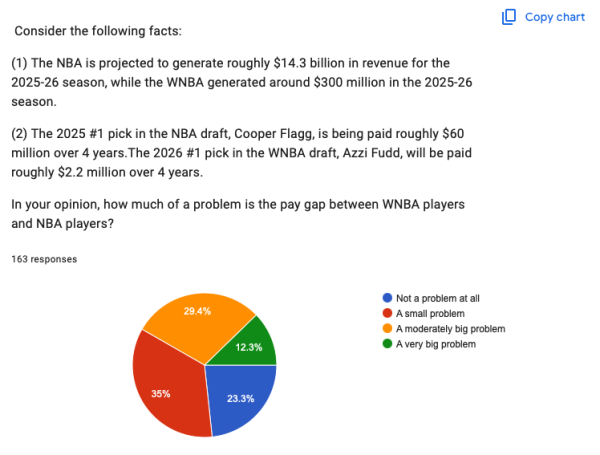
After years of success and growing popularity, women’s professional athletes still earn far less than male athletes, leading to debates about fairness, revenue and the value of women’s sports. The pay gap between NBA and WNBA players currently is significant and controversial, and it is shaped by the difference in league revenue, viewership and sponsorships. While NBA players have significantly higher pay than WNBA players, some people argue that there are issues like marketing coverage and inequalities in the leagues that need to be addressed for women to have more equal pay. In grades nine to 12, 163 students took an Imua survey posted on the Daily Bulletin about this topic. 76.7% of ‘Iolani students and a majority of interviewees thought that the pay gap between WNBA players and NBA players was an issue.
Students’ Opinion on the Pay Gap
Opinions from the Imua survey varied on how severe the problem is. Out of the percentage that thought the pay gap between the WNBA and NBA is a problem, 12.3% thought it was a very big problem, 29.4% thought it was a moderately big problem, and 35% of them thought it was a small problem. On the other hand, 23.3% of the students said that it is not a problem at all.
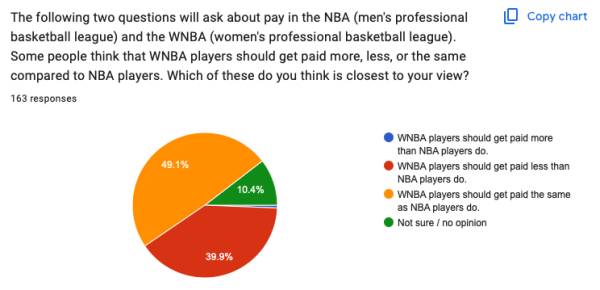
A majority of survey respondents, 49.1% of ‘Iolani students, thought that WNBA players should get paid as much as NBA players. On the other hand, 39.9% of ‘Iolani students thought WNBA players should get paid less than NBA players. These survey results reflect a larger debate about why such a major pay gap exists in professional basketball today.
Revenue and Salary Differences Between WNBA and NBA Players
There is a significant pay gap between NBA players and WNBA players because of the difference in generated revenue, viewership and overall support from other corporations.
On EBSCO Gender Equity in Professional Sports: Overview, Joy Crelin said, “Caitlin Clark, the league’s number-one pick in 2024, received a four-year contract for $338,056, as compared to the top 2024 NBA Draft pick, Zaccharie Risacher, whose initial contract was for $57.2 million.” The reason behind this is because the NBA generates roughly $10 billion a year, while the WNBA generates around $200 million a year. The NBA distributes 50% of its revenue to the players, and on the other hand, the WNBA gives out only 10% of its revenue to its players. As a result, on average, the difference between the pay of WNBA and NBA players is in the millions.
From EBSCO Point: Women’s Professional Sports Deserve Equitable Treatment Crelin said, “Peter Keating noted that although WNBA player Nneka Ogwumike and NBA player Anthony Davis had both been number-one draft selections in 2012, been selected for All-Star teams six times, and recorded comparable season statistics, Ogwumike earned only $115,000 for the 2019 WNBA season, while Davis earned $27.1 million for the 2019–2020 NBA season.”
Perspective: WNBA Players Should Earn Less than NBA Players
As a result, some people believe WNBA players should earn less than NBA players because the NBA generates more revenue and viewership based on athleticism. Crelin of EBSCO said, “Women’s sports are inherently different from men’s sports, and it would not be appropriate for women and men to receive the same compensation.” Men’s basketball showcases more athleticism than women’s basketball.
Mr. Mike Among, coach for the ‘Iolani Intermediate Girls Basketball team, believes that WNBA players should be paid equally but understands why people might think otherwise: “But I would think [some viewers] would put value on athleticism. You know, with the men’s game, you get a whole lot of dunking and a whole lot of what people might term athletic plays…
and [in] the women’s game the focus is probably a little bit more on the skills. Ball handling [and] shooting, in order to gain an advantage.”
Crelin of EBSCO said, “Men in professional sports are stronger, faster and compete at a higher level than women and that the work being performed by male and female athletes is therefore not comparable.”
The difference in athleticism between the players in the WNBA and NBA is one of the major reasons why the WNBA has significantly less viewership, leading to less generated revenue. Crelin said, “The NBA generated about $10 billion in revenue (2021-2022), while the WNBA generated between $180 and $200 million in revenue…some argue that the lower salaries paid to women in professional sports are financially appropriate.”
Since the WNBA has less viewership and revenue, the organization is not financially stable enough to share a larger portion of money to the WNBA players. Mr. Lance Suzuki, an AP Economics teacher at ‘Iolani, said, “I think the WNBA was in a weak financial position, so the league wasn’t comfortable giving up a greater percentage.” In addition, not many sponsors would want to collaborate with a financially unstable business.
Perspective: WNBA Players Deserve Equal Pay as NBA Players
Others argue that WNBA players deserve equal pay because they work just as hard and achieve success at the same competitive level as NBA players. WNBA players and NBA players are high-level and elite in their expertise, basketball. Crelin from EBSCO said, “Women’s sports teams and individual competitors in the United States have performed as well as or better than their male equivalents in competition.” With more exciting female athletes being drafted such as Caitlin Clark, the WNBA viewership has increased a lot. The 2025 WNBA season is the most watched regular season and postseason ever in WNBA history.
Charlie G. ’29, an ‘Iolani Varsity Girls Basketball player, said, “I feel like they should definitely get paid the same because, I mean, they’re doing the same exact thing.
It’s really just based on viewership, and not that many people watch the WNBA as they watch the NBA.”
On the other hand, Mr. Among said, “I think the league is shorter.
There aren’t as many games for women. And they’re hugely popular, and they should be paid equally.” With more viewership and popularity in the WNBA, the players should get paid more. On EBSCO, Crelin said, “Writing for the Guardian, Alvarez emphasized the need for a more systemic approach, stating, “Women’s sports will not achieve parity if the barriers that keep them in the trenches remain.” She further argued that the responsibility for combatting the systemic inequity of the sporting world must fall not only on governing bodies and sports leagues but also on the corporations that sponsor them.” The player’s salary is entirely based on the base contract given by the corporations, but also influenced by brand deals made by other companies.
Ultimately, majority of the interviewees, and ‘Iolani students think that the pay gap between the WNBA and NBA is a problem that should be addressed. Overall the debate over equal pay in professional basketball is not only about the money, but also the fairness, opportunity, recognition and how people value women’s sports.