













A flood does not need to reach our campus to reach us. The moment stormwater begins swallowing classrooms and the fragile stability of a child’s school day, the crisis stops belonging to somewhere else. It becomes a question of whether we believe education is worth protecting as a basic human right, and how quickly we allow disruption to fade into the background once the skies clear. That question becomes especially hard to ignore when the damage strikes within our own island community.
Between deadlines, practices and the steady churn of student life, it is easy to let the North Shore settle into memory as another grim headline: tragic, briefly discussed, and then eclipsed by everything due next week. But these floods demand more than passing sympathy. They disrupted the education, stability and mental well-being of students on this island. And if disaster response is not only about surviving the immediate moment, but also about recovery, rebuilding and preparing so the next crisis harms less, then students should not see themselves as spectators to that process. They should see themselves as part of it.
So…What happened?
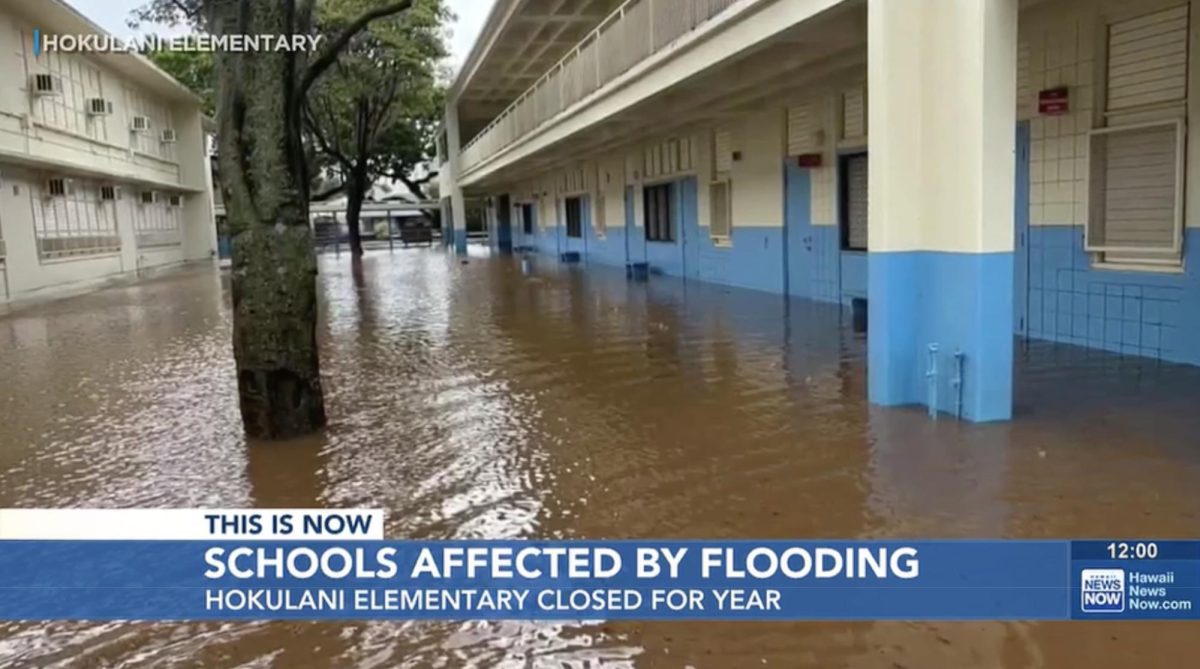
The March 2026 storms triggered statewide school closures and forced several campuses to confront severe structural damage. According to Hawai‘i News Now, Hōkūlani Elementary, among the most affected, will remain closed for the rest of the school year, with students relocated across campuses while remaining with their original teachers.
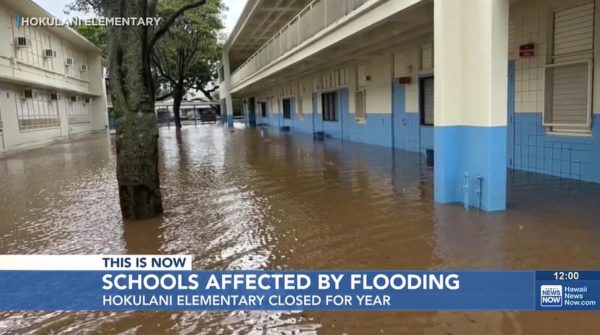
Administrative continuity may preserve instruction, yet the sense of place that secures learning has been interrupted. For younger students especially, whose development depends on familiarity and a sense of routine, displacement changes the physical location of their education as well as the internal experience of learning itself.
Public attention, however, often travels faster than recovery. As headlines renew, the crisis appears to recede, even as its detrimental effects remain. Reporting from KHON2, a Hawai‘i-based news station with community-level coverage, indicates that “recovery is far from over,” with families continuing to confront wrecked homes and limited resources weeks after the storm. Visible high-water marks and stripped interiors remain across affected areas.
Why does this matter to us?
The distance should concern students across O‘ahu, in part because the most serious consequences of a disaster are often the least explicitly visible. Education depends on assumptions that:
1) Transportation will reliably bring students to campus;
2) Classrooms will persist as stable environments;
3) Learning will resume the next day without disruptive pauses.
The floods exposed how displaced students must now maneuver longer commutes, unfamiliar campuses and revised habitual patterns, all of which introduce barriers to consistent attendance and focus.
Furthermore, research from the Substance Abuse and Mental Health Services Administration asserts that children vulnerable to disasters may experience “PTSD, depression, and acute stress disorder,” alongside prolonged anxiety and emotional distress. Even when symptoms are not immediately apparent, young people often personalize instability in ways that affect their concentration, emotional regulation and sense of safety. More recent guides from the same source find that children may feel “scared, confused, or anxious,” reactions that can emerge either immediately or long after the event itself.
These effects are frequently underestimated because they do not leave physical traces. A damaged building can be repaired. A broken sense of security cannot be reconstructed as firmly. For younger students, even temporary displacement can permanently deter their ability to associate school with safety and routine.
How can we help?
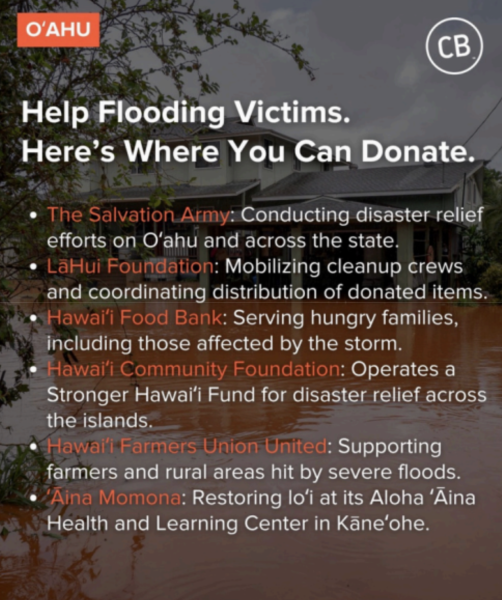
In the face of that volatility, student response can begin with small deliberate actions. Short-term support matters just as much as large-scale intervention. Students can work with established relief efforts such as those listed below.
- Kāko‘o Oahu Fund by the Hawaiian Council
- Stronger Hawai‘i Fund by Hawai‘i Community Foundation
- Hawaiian Humane Society
- Lāhui Foundation
- North Shore Flood Relief Fund by the North Shore Chamber of Commerce
- Hawaiʻi Community Lending
Donations can also be made to the following foundations who are directly contributing to the communal efforts to rehabilitate and reverse the damage caused.
Beyond financial assistance, students can offer something of equal meaning: connection. Writing letters to schools such as Pālolo or Ali‘iolani that have welcomed displaced students, or messages of support to Hōkūlani teachers and students, can help restore a sense of community. Even small gestures, such as pen-pal style exchanges, allow students experiencing disruption to feel seen beyond the circumstances of the disaster.
Hi there!
My name is Bobbery Van Smith, and I am a junior at ‘Iolani School. I know school has probably felt super different lately, so I just wanted to send you a little note and say that a lot of students are thinking about you guys and cheering you all on!
A random fun fact about me: I really like alpacas! I think they are such fluffy creatures that are not afraid to have an expressive personality.
I hope your new classrooms feel a little more familiar everyday. Even if things are weird right now, know that we all care about you. You are being really brave by showing up and adjusting to so much change.
Sending you big ‘Iolani aloha,
Bobbery Van Smith
Caption: Sample pen-pal letter to Hōkūlani Elementary student
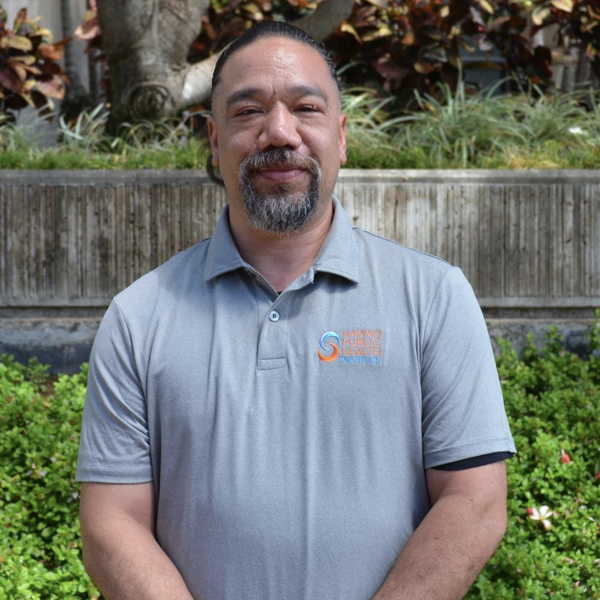
Sustained impact, however, depends on what follows immediate response. Long-term recovery is assembled within legislative space, where infrastructure, funding, and preparedness are determined. Hawai‘i vulnerability to disruption, including its reliance on centralized systems such as Honolulu Harbor, has been documented in research by the University of Hawai‘i Sea Grant program. Addressing these vulnerabilities requires policy attention and public engagement. Students are not excluded from this process. As Hawai’i Youth Food Council coordinator Mr. Kawika Kahiapo explains, legislators are public servants who must understand the people they represent, including youth voices. He further observes that when students speak, “[legislators] actually pay attention,” signaling that youth presence can influence how issues are received often at a higher magnitude to adult participation.
Through the Hawai‘i State Capitol website, students can identify their district representatives and senators, whose decisions directly affect their communities by clicking on the specific legislators.
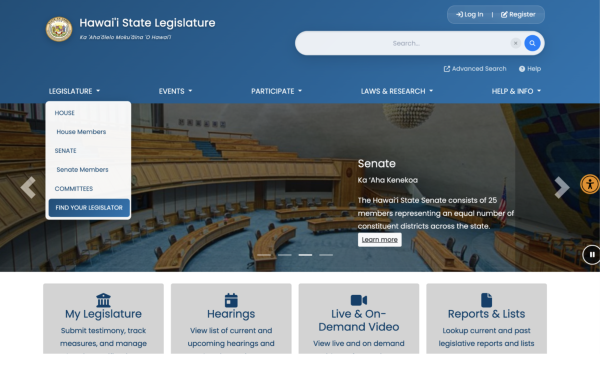
As constituents, students hold a position that encourages responsiveness. Writing to legislators, advocating for policies that build disaster preparedness along with supporting initiatives that promote sustainable agriculture and infrastructure resilience are concrete pathways to contribute to long-term change.
Remember…
The water will continue to recede, as it always does. What remains uncertain is whether attention recedes with it. If one storm can dislodge students from their classrooms, then the rest of us have no moral luxury of apathy; we have a responsibility to care before disrupted education is ushered out of public memory.