






















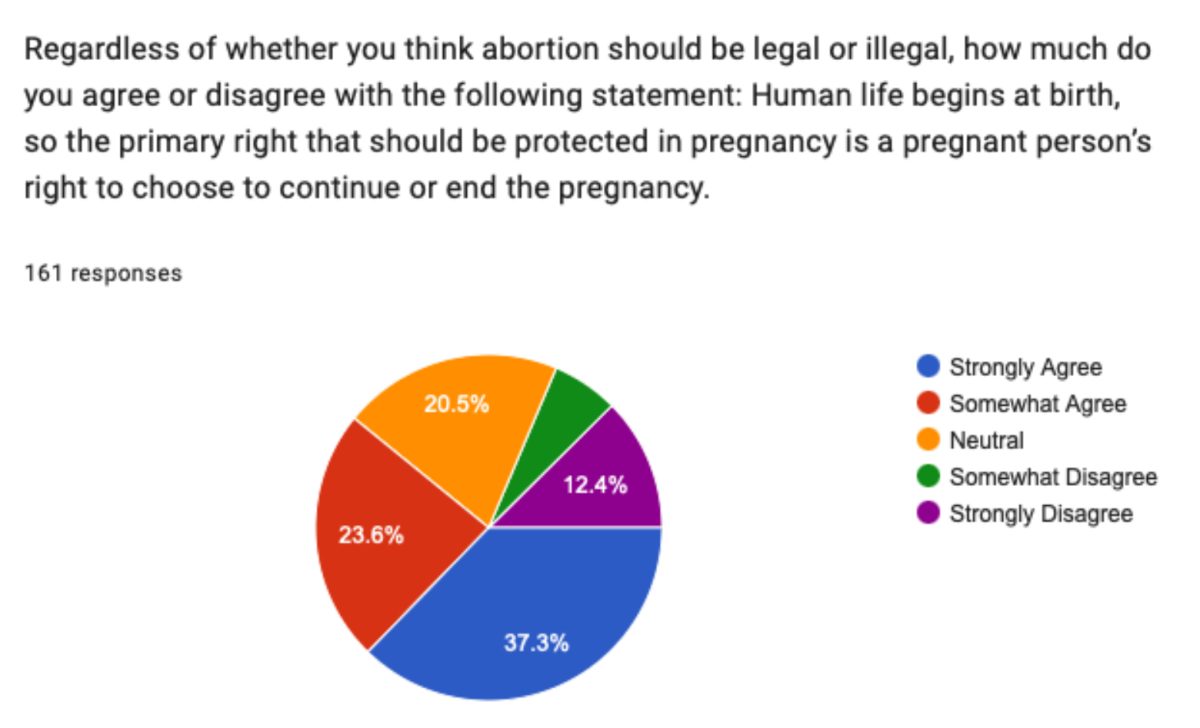
A woman’s decision to have an abortion is one that can be very difficult, and one that many people are lucky to never experience. In recent years, debates over abortion rights in the United States have escalated. Some people say that whether or not a pregnant woman wants to have an abortion should be her choice. Others argue that abortion is considered murder, and should be illegal; this view is often closely connected to religion. In a survey posted in the ‘Iolani Daily Bulletin, 161 students in grades 9-12 shared their views on when a human life truly begins. 60.9% agreed that it begins at birth and the primary right that should be protected is a pregnant person’s right to choose whether to continue or end the pregnancy,while 25.5% agreed that human life begins at conception and an embryo’s right to live should be protected. This data doesn’t necessarily show whether or not students think abortion is right, but it shows that the majority of respondents believe life begins at birth and a woman should have the right to choose.
‘Iolani Students’ Opinions on Abortion Rights
When 161 ‘Iolani students were asked how much they agreed with the statement, “Human life begins at birth, so the primary right that should be protected is a pregnant person’s right to choose to continue or end the pregnancy,” 60.9% of students strongly or somewhat agreed, with less than a 2% difference between male and female identifying students’ results. Students were also prompted with how much they agree with the following statement, “Human life begins at conception, so the primary right that should be protected is an embryo’s right to life.” 25.5% of respondents strongly or somewhat agreed, with a 4.1% difference. Surprisingly, the data shows that men’s and women’s views on whether the right to abortion belongs to a woman were very close in agreement, with only slightly more agreement from women that the primary right is a pregnant person’s right to choose.
Pro-choice Perspective
Those who support a woman’s decision to have an abortion are often referred to as “pro-choice.” The argument of those who identify as pro-choice mainly implies that the choice of whether or not a pregnant woman wants to continue or end a pregnancy should be her own. However, with recent government actions and the overturning of Roe v. Wade, a woman’s right to an abortion has changed greatly. Ms. Ashley Murray, an ‘Iolani English teacher, said, “As a woman, obviously, this issue matters a great deal to me, and as a teacher of young women, I know that these kinds of issues, like the overturning of Roe v. Wade, really put young women in a situation where they do not have control over their bodies.”
Ms. Murray said, “If you take away a woman’s right to choose, what you’re also doing is putting power in the hands of the government — especially because it’s more heavily dominated by men. You’re placing that power in their hands over a woman’s body, and that, to me, is so incredibly problematic.”
When asked about her opinions on abortion, the Director of Healthcare Transformation at Essential Access Health, a non-profit organization that advances sexual and reproductive health equity, Ms. Alissa Nelson said, “There can be a lot of both physical impacts of a pregnancy, but there’s also mental health impacts of pregnancy, and not everybody can handle that. So, my take is, no matter where you are, no matter who you are, you should be able to access an abortion, and one that works in a way that is best for you.”
Pro-life Perspective
The anti-abortion perspective, often referred to as “pro-life,” sprouts from arguments over religion and the qualification of a human life.
Stated in an article from Points of View Reference Source, common effects for women who have had abortions include “sadness, depression, guilt, anxiety, numbness, and shame.” Therefore, many argue that abortions should be illegal to prevent these outcomes.
Mr. David Buchanan, a Religion teacher at ‘Iolani, said, “Human life is basically inviolable, that is, I don’t believe it is morally right to take an innocent life, and because I believe that babies in the womb are individual humans, I believe that in most circumstances, abortion is morally wrong.”
However, many pro-life people have mixed opinions on when a life begins and after how long abortions should be allowed, given that it is such a complex issue. “I think there are certain circumstances in which abortion is required to save the lives of other people. So, in that case, abortion, or the taking of the innocent life, is not the goal of the abortion. The taking of an innocent life is a result of [saving another’s],” Mr. Buchanan said. “[In some circumstances], the state needs to make some allowances for personal choice.”
How Religion is Brought into Abortion Conversations
Religion, more specifically Christianity, is often brought up in conversations concerning abortion when discussing the qualifications and rights of a human being. Mr. Buchanan said, “Religion is used to say that all individual humans possess the right to life, regardless of their stage of development… and that’s a right that’s given to them by God, then it is morally wrong to perform abortions.”
On the other hand, Ms. Murray, who grew up in a very fundamentalist Christian environment, said, “If we’re talking in biblical terms, Jesus never said that. He never said that there were moral absolutes. And I would be very fascinated to hear what he would say about this topic.”
Current U.S. Laws Regarding Abortion
Currently in the United States., different states and territories have different laws concerning abortion rights. Abortion is banned in 13 states, while 6 states have gestational limits between 6 and 12 weeks, and 4 states have gestational limits between 18 and 22 weeks. 18 states, including Hawai‘i, allow abortion until near viability, meaning the baby has the ability to thrive, and 9 states plus DC have no gestational limits.
Statistics indicate that restricting access to abortion doesn’t reduce the number of abortions, it only causes health risks and discriminates against the poor, since an abortion pill can often cost from $500 to $1000 without insurance.
A poll done by the Pew Research Center in 2022 showed that 43% of respondents strongly disapproved of the Supreme Court’s decision to overturn Roe v. Wade, while 25% strongly agreed with the decision.
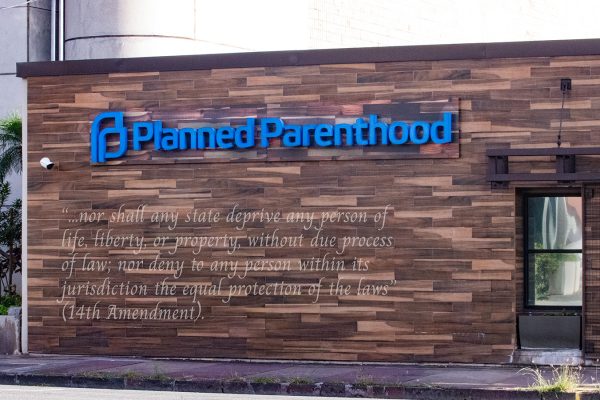
The 14th Amendment states that “…nor shall any state deprive any person of life, liberty, or property, without due process of law; nor deny to any person within its jurisdiction the equal protection of the laws.”
The primary holding of the decision of Roe v Wade, recognized by the U.S. supreme court, states that “A person may choose to have an abortion until a fetus becomes viable, based on the right to privacy contained in the Due Process Clause of the Fourteenth Amendment. Viability means the ability to live outside the womb, which usually happens between 24 and 28 weeks after conception.”
Keeping an Open Mind
The topic of abortion is a very complex one, and one that many people don’t enjoy discussing. However, there are many different opinions on abortion in our country, and it is important to remember, like Ms. Murray said, “there should be a willingness to try to understand, even if you don’t agree.”