





















Democracy doesn’t begin on your 18th birthday. It begins the moment you are born because that’s when lawmakers’ policies begin affecting you. It starts the moment you enter a system already written for you. Laws create your educational institutions, your healthcare, your social environment long before you can vote. The earlier you engage, the earlier you stop being designed and start designing the rules that govern you. Why wait until adulthood to pay attention?
From January to May each year, lawmakers gather at the Hawai‘i State Capitol to debate and pass legislation during the state’s legislative session. While voting may be restricted to adults, participation in the process is not. Students can track bills, attend hearings, and submit written or oral testimony through the state legislature’s website.
For students at ‘Iolani School, who have access to research databases, mentorship and advocacy-focused clubs, methods of engagement may be more accessible than they first appear.
Why ‘Iolani Students are Uniquely Positioned to Participate
Students often possess a stereotypical assumption that the legislative process is reserved for middle-aged businessmen in gray suits, speaking in committee rooms that feel a thousand miles away from a classroom desk. In reality, the resources and skillsets students receive may be superior to what some grown-ups obtain.
Alongside an extensive information archive and mandatory classes that teach necessary skills like research, public speaking and persuasive writing, many extracurricular clubs (from Speech & Debate and Model UN to Key Club) already encourage the same analytical and communication skills needed for policy action!
Existing youth organizations also provide direct passages to civic engagement. Groups such as the Climate Future Forum, Hawaii Youth Food Council and Citizens’ Climate Lobby Hawai’i (CCL) are all examples of student-oriented platforms. The gateway to youth participation isn’t a secret Hogwarts passage, you don’t need an owl-delivered invitation to be accepted.
Why Youth Civic Engagement Matters
So, who does early involvement benefit? Research shows that students who participate in civic life early are more likely to become active voters as participation can “ignite a passion […] that lasts a lifetime.” And when young people stay involved, the impact reaches beyond the individual: civic participation nourishes communities, assembles political efficacy and helps democracy represent the people it actually governs.
That matters especially now, when many young adults are less likely to follow politics or even see voting as important. The reasons are understandable. Politics often appears as polarized and inaccessible, dominated by professionals who speak a language of bills, amendments and referrals. But politics does not wait for our attention. As The Michigan Daily puts it, “the people who are elected, the laws that are passed, every action made possible by politics affects your everyday life dramatically.” The consequences of inaction are intimate. Ignoring it does not remove its influence, it simply removes one’s voice from the conversation.
Students are Already Making an Impact
Across Hawai‘i, youth advocates are already demonstrating that student voices can influence policy discussions.
Ms. Meg Turner, Committee Clerk and Office Manager for Senator Mike Gabbard, said youth engagement is not only increasingly common but also very welcomed: “One youth group we work with is Hawaii Youth Food Council. We’ve helped introduce several bills for them over the years. We’re always happy to see them getting involved!” From the viewpoint of lawmakers, youth testimony can contribute to the impacted constituents that legislators consider.
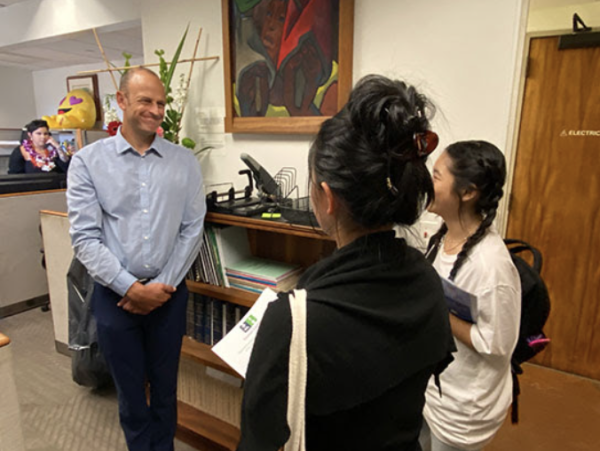
“Youth testimony helps lawmakers understand the perspective of the younger generation,” said Mr. Glen P. Young, Office Manager for Senator Karl Rhoads. “It allows them to factor in those perspectives during decision-making.”
Students themselves often discover that the legislative process is far less intimidating than they initially expected.
Sophia P. ’28, a student involved in climate policy advocacy and the club leader of CCL, first became interested in legislative work out of curiosity. “The lawmaking process can look like a black box,” Sophia said. “But it really isn’t that mysterious once you start learning about it.” Her curiosity eventually led to a moment that revealed just how real youth influence can be. After presenting a policy proposal at the Climate Future Forum in November, Sophia recalled that Representative Ikaika Hussey approached her with an unexpected question: “Would you be willing to work with me to turn this into a real bill?”
“That was one of the highlights of my life,” she said.
The First Steps are Easier Than You Think
Advocacy does not require hours at the Capitol or a deep background in political science. Often, it begins with something many students already possess: curiosity.
Mr. Paul Bernstein, a mentor with CCL, recognizes that students do not need to venture into the process alone. “It’s often easier to advocate as part of a group,” he said. “Getting involved early builds habits of engagement.” Students who participate also gain skills unrelated to politics. Reading legislation develops critical thinking. Writing testimony perfects persuasive argumentation. Engaging with lawmakers teaches students how to manage disagreement and conflicting opinions.
For student advocate Tata L. ’27, the experience intrinsically changed how he viewed the political system. “Democracy, free speech and civic participation are the bedrock of society,” he said. “If those were things I had to be afraid of, America would not be America.”
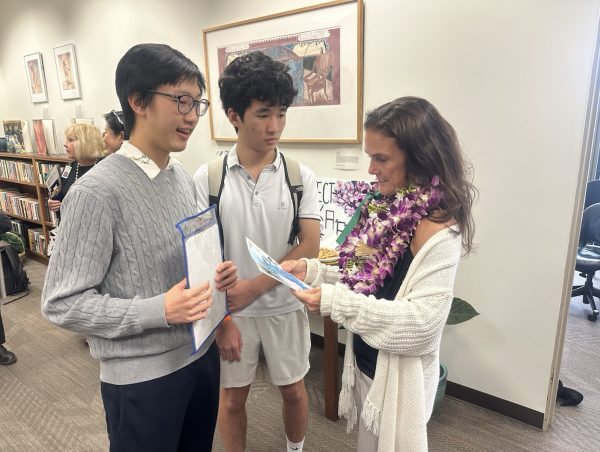
What You Can Do Right Now
Getting involved in the legislative process may sound complicated! But if there’s a will, there’s a way. Let’s begin with a few simple steps.
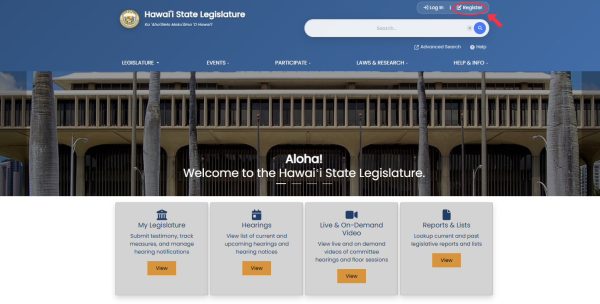
1. Create an account on the Hawai‘i State Legislature website. Once registered, users can track legislation and submit testimony online.
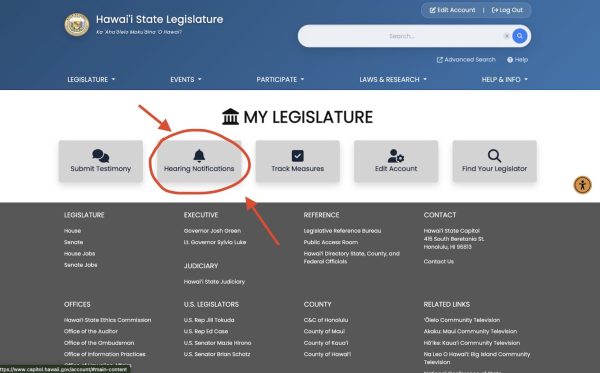
2. Track bills and receive hearing notices. Students can follow specific bills or committees to receive email notifications whenever hearings are scheduled. *NOTE: Simplified, each bill is referred to one or more committees and it needs to be heard and passed by those committees in order to become law.
3. Submit testimony: when a bill is scheduled for hearing, anyone can submit written testimony online anytime 24 hours before the hearing. They can also sign up to provide oral testimony through Zoom or in-person during the actual time. (*NOTE: The legislature is mainly open Monday-Friday during school hours. Providing oral testimony might be difficult unless a free/meeting/lunch period fits.) The testimony would be around one to two minutes orally, or a few paragraphs written (describing why this issue matters to you and your stance). Here is an example!
Aloha Chair [Legislator Last Name] and Committee Members,
My name is [Name], and I am a student at ‘Iolani School.
I am submitting testimony in support/opposition of [Bill Number].
I support/oppose this bill because [brief reason: why you think this bill matters / problems].
As a young person, [Why should they care? e.g. I believe it’s important that our legislature considers policies that ensure the safety and well-being of all youth. This bill aligns with that goal].
Thank you for your consideration.
Mahalo,
[Your Name]
Grade / School (optional)
Students who want a walkthrough of the system can also watch this step-by-step guide.
The legislative process may seem hidden behind marble walls and procedural language. But the reality is far more ordinary and accessible. Behind every bill are human conversations, testimonies, and individuals who chose to use their voice. Thus, at lunch, you can scroll on Instagram for five minutes, or you can submit one testimony that may influence a lawmaker’s opinions on passing actual legislation that governs our daily lives.