















While many people find it hard to believe, Hawai‘i’s history is immersed in imperialism, or when a country extends its power beyond its borders, as it was territorialized by the United States in the late 1800s. As a person who has lived in Hawai‘i all my life, I understand the difficulties of being imperialized. Through my grandparents, who lived through Hawai’i’s journey from a territory to a state, I was able to see the harms of imperialism: the poor treatment of those living in the Hawai‘i, the depletion of natural resources and the overall lack of representation for those in the territory, especially Native Hawaiians and the loss of their culture.
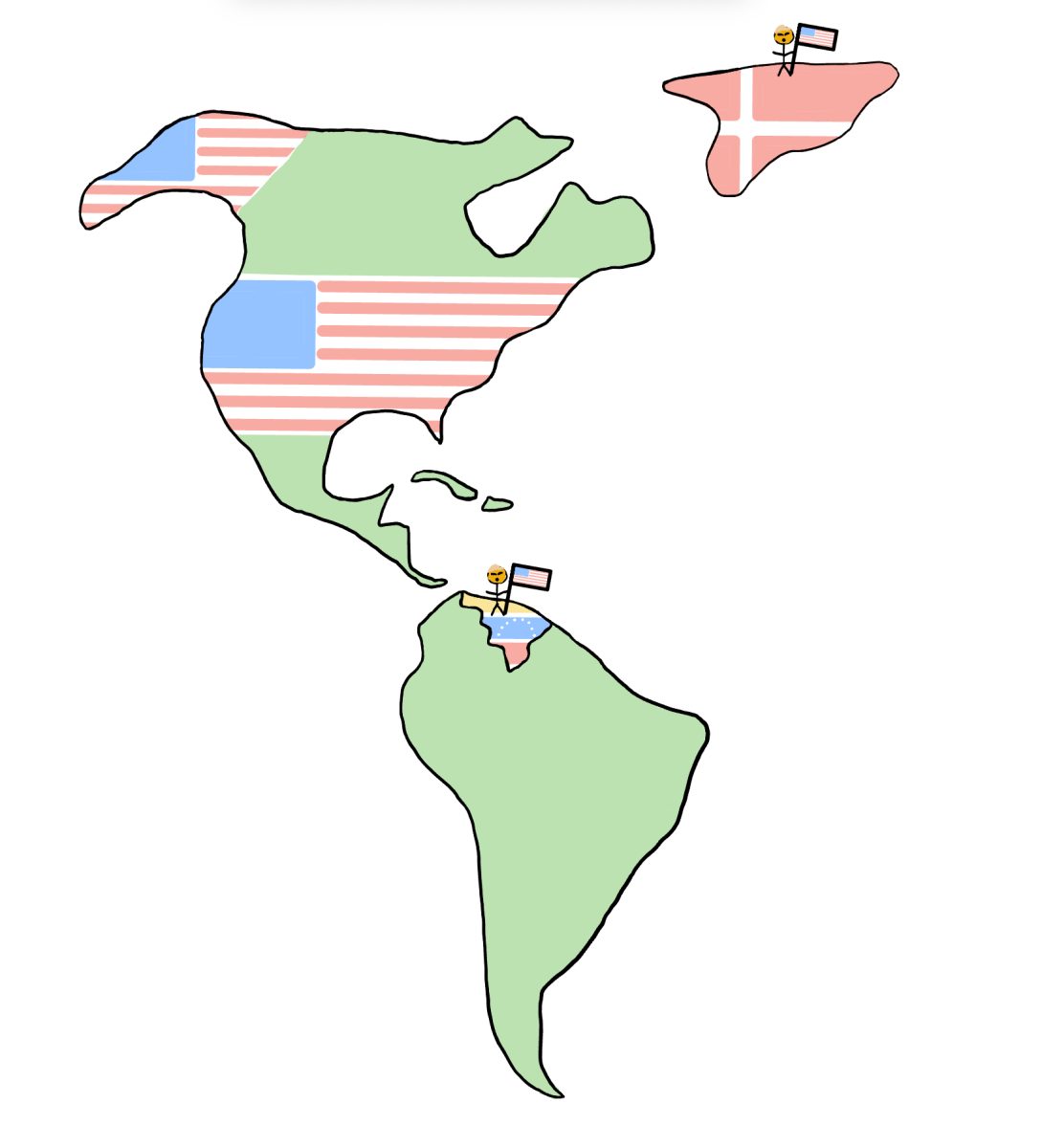
Despite being founded on ideals of liberty, the United States has become increasingly related to imperialism. President Donald Trump’s interest in Greenland and Venezuela is a reflection of a dark imperialist legacy from past centuries of American ideology. These moves by the president reveal his hidden economic motivations. It continues a cycle of difficult foreign relations due to increasingly polarizing decisions on the United States’ behalf. The U.S. government should be limited to intervention in countries when there are dire humanitarian situations. As humanitarian crises rise, it is of utmost urgency that we as a country prioritize human rights.
History is often used to justify the present, and we are heading towards similar circumstances as those approached in the 1890s by the American people. However, we should learn from history so we don’t repeat past mistakes and atrocities.
Current Events: Greenland
President Trump’s main motives for imperialism in Greenland are the natural resources that they possess that would boost the U.S.’s economy and its geopolitical value. Current events in Greenland show the United States’ desire for acquiring new land. Spending money that the United States does not have access to or taking military action to invade Greenland would present challenges for American citizens and international issues. Mr. Trump’s threats of tariffs demonstrate how far the administration would go to continue imperialistic policies as it would damage foreign relations with most countries. Greenland is known for its natural resources and metals such as yttrium, zinc and lead.
In addition, its placement in the Arctic Circle makes it valuable land for geopolitical reasons that concern national security. According to CBS, the United States also has a military base stationed in Greenland and, as President Trump claims, there is a threat of China and Russia potentially attacking the United States through Greenland. In a press conference held in the Oval Office on Jan. 14, 2026, President Trump stated that “Greenland is very important to [U.S.] national security, including Denmark.”
Should economic interests and national security concerns justify threats of violence and aggression towards Denmark and Greenland? The answer, plain and simple, should be absolutely not. It is important to make the distinction that, while there is no threat of violence to those living in Greenland at the moment, Greenlanders have made it clear that they do not approve of seceding from Denmark. According to NBC news, the costs of purchasing Greenland for $700 billion dollars, including the possibility of paying each of Greenland’s 57,000 citizens a sum of at least $10,000, outweigh its benefits as the United States is already at a new high of $38.4 billion in debt. It is clear that a takeover of Greenland would not be in the best interest of the American economy as it would sink the government further into debt as well as spending millions of U.S. taxpayer dollars deploying the U.S. military into Greenland.
Current Events: Venezuela
Venezuela’s history of humanitarian issues is being used as justification by President Trump for United States involvement. Venezuela, a country in South America that depends heavily upon the trade of oil, has faced many humanitarian problems due to government corruption and lack of international transparency. Negotiations of oil have often not involved any Venezuelan representation because of former President Nicolás Maduro’s decision to limit Venezuelan oil from international trade. Under Mr. Maduro, many Venezuelans fled to the United States due to violations of human rights, poor handling of the economy, corruption in the government and many drug trafficking allegations directed towards the former leader. However, corruption and humanitarian crises remain current in the country. While there is no question that Maduro was violating human rights through his policies, such as running raids that targeted his political opponents, there are some who believe that the seizure of the president goes far beyond just human rights.
However, AP U.S. Government teacher Ms. Heather Muraoka ’95 thinks that the language surrounding Venezuela is charged but not necessarily imperialist. She said “I don’t know that they’re acting entirely in an imperialist way. They are acting in a unilateral way. America is doing stuff without consulting other people. They are talking like imperialists.” The U.S.’s motives can be seen as different from how an imperialist country would act. It is clear that the United States is making moves that can be seen as an attempt to control Venezuela, but it does not immediately reflect imperialism. However, this is imperialism because the U.S. is controlling the distribution of natural resources and would reflect taking control of Venezuela’s economy.
History of Imperialism
Greenland and Venezuela have an important connection to a continuous cycle of imperialism that the United States has used for accumulation in wealth and power. While its methods have shifted across centuries, the essential character of imperialism continues to be expanding power for geopolitical or economic reasons.
The United States has used humanitarian issues to justify economic and geopolitical gains in the past. One main example that is forgotten by many is the Spanish-American War and the Philippine-American War. In the 1500s, the Philippines were first acquired by Spain by Ferdinand Magellan. The Spanish were known for their brutal treatment of the indigenous people due to forced labor, seen in the treatment of Native Americans following the development of plantations in the Caribbean and later in the Philippines. Seeing the brutal treatment of the Filipinos, the U.S. President at the time, William McKinley, went to war with the Spanish to fight for the Filipinos’ freedom. During this time period, there was a huge increase in imperialism mainly from European powers that were fighting to become empires. The war ended in 1898 and resulted in full American control of the Philippines. Following the end of World War II, the Philippines declared their independence from the United States in 1946. Propaganda spread by the federal government during this time portrayed the American government as the “white savior” for rescuing who they believed were uncivilized Filipinos and encouraged them to support imperialism of other countries.
Connection to Venezuela Current Events
Similarly, the United States saw the inhumane treatment of Venezuelans and invaded with the intent to change the government. However, it is becoming more apparent that the United States is taking an economic approach on the takeover of Venezuela in its aftermath as it fights over the control of Venezuela’s oil reserves. The U.S. has started shipping Venezuelan oil to the United States in a move that is seen as taking control of the economy. This amount of oil being shipped to the United States is notably larger than ever before; an idea that the former president strongly opposed due to interactions with foreign relations. Acting President Delcy Rodríguez, is now hesitant to cooperate with the United States’ demands as many are involving economic motives that would undermine Venezuelan’s control over the distribution of their oil resources. Per CNN, “Rodríguez has pushed back on the U.S., amid ongoing pressure including a series of demands for Venezuela to resume oil production.” Ms. Rodríguez was originally the Vice President under former president Maduro, before assuming the position under the assumption that she would cooperate with the wishes of the U.S. Federal government.
The past of the United States showcases the brutal history of imperialism as well as many flaws and oversights that can be used and implemented to this day. In Venezuela, it would be most effective and beneficial for all parties involved for the United States to support the Venezuelan government but not interfere in the economy as much as possible, as being completely involved would cost the United States billions of dollars that the United States does not have. As a new president has been appointed, Rodriguez has prioritized the release of many of Maduro’s political enemies, one of the main causes for outcry against his regime.
As the United States evolves, it is important to reflect on those who have shaped us in the past and it is impossible to ignore the dark history that has led us to this moment. We are at a precipice of losing our status as a world power, yet asserting dominance over other countries that we have no business imperializing is not how we regain the international world’s trust. We must repair foreign relations, increase trade, and focus on the well being of citizens before growing profit margins because without people to live in a country, who will benefit from long term economic growth?